Industrial 3D Printing for Production Parts: From Prototype to Validated Lot
Content in this Article
Industrial AM can look straightforward in CAD and still fail after printing, finishing or inspection. The useful question is not whether a process can make the geometry once, but whether the chosen material, orientation and acceptance method can deliver the required function repeatedly. This guide turns that decision into a practical review workflow.
- Define the operating environment, functional load, quantity and acceptance criteria before choosing a process.
- Treat dimensions and performance values as design-starting points; confirm the exact grade and supplier capability before release.
- Use a first article or pilot lot to lock inspection and process controls before scaling.

Start with requirements and process selection
What production actually means here
Most teams moving from prototyping to production underestimate the documentation load. A prototype is judged on whether one part looks right. A production part is judged on whether the 500th unit still meets spec, whether the records prove it, and whether a regulator or customer audit would accept the evidence next year.
Industrial AM at this level is less about machines and more about a controlled system: validated build parameters, controlled feedstock, trained operators, calibrated inspection, and a document trail that ties every part back to a specific build, machine, operator, and powder lot.
Prototype versus production: what really changes
The geometry may be identical, but the surrounding manufacturing system is different. The shift is from making one acceptable part to operating a process that is statistically capable of making many.
| Dimension | Prototype mindset | Production mindset |
|---|---|---|
| Batch size | 1 to 5 units | 100 to 10,000 units per release |
| Documentation | Build file, optional | Material cert, build log, FAI, CoC required |
| Lot traceability | Rarely tracked | Powder lot, machine, operator, date, build number |
| Certification | None or informal | ISO 9001 baseline, AS9100 or ISO 13485 by sector |
| Acceptance | One sample approved | Sampling plan across multiple builds |
| Change control | Ad hoc | ECN with re-qualification criteria |
Industrial AM: define requirements before selecting a process
Connect requirements, process decisions and inspection before the first build to reduce late design changes.
- 1Requirements
Function, service environment, quantity and failure risk
- 2Material and process
Material grade, build strategy, geometry and finishing
- 3Inspection
Critical dimensions, functional tests and lot records
Key design rules
Quality systems and the records that follow the part
A production AM supplier is evaluated on its quality system as much as on its machines. ISO 9001 is the floor. AS9100 adds aerospace-grade risk and configuration control; ISO 13485 adds medical-device traceability, biocompatibility, and validated cleaning.
| Stage | What is controlled | What is recorded |
|---|---|---|
| Incoming | Powder lot certificate, sieve, moisture | Lot ID, supplier CoC, receipt date |
| Pre-build | Machine calibration, recoater, gas purity | Machine ID, parameters, operator |
| In-process | Melt pool or layer monitoring, O2, temp | Sensor log, alarms, pauses |
| Post-process | Heat treat cycle, HIP, support removal | Furnace chart, HIP record, traveler |
| Final QA | CMM, CT, surface, tensile coupon | FAI, dimensional report, CoC |
Certifications shape what a shop is allowed to quote on. An AS9100-registered facility can take flight hardware; an ISO 13485 facility can take patient-contact devices; an ISO 9001 shop covers general industrial work. A part needing both aerospace and medical approval needs the right supplier from day one, because retrofitting a quality system around a program is slower and more expensive than choosing correctly at the start.
The economics: tooling break-even versus AM unit cost
Injection molding and die casting will always beat AM once volume is high enough to amortize tooling. But for many production families, volume never gets that high, or the family contains too many variants for a single tool. AM wins at high mix and low-to-mid volume because its unit cost barely moves with batch size and there is no tooling to amortize.
| Annual volume | Variants | Typical winner |
|---|---|---|
| Under 500 | Any | AM |
| 500 to 5,000 | High (>5) | AM usually |
| 500 to 5,000 | Low (1-2) | Case-by-case |
| 5,000 to 50,000 | High | AM or hybrid |
| 5,000 to 50,000 | Low | Tooling |
| Above 50,000 | Any | Injection / casting |
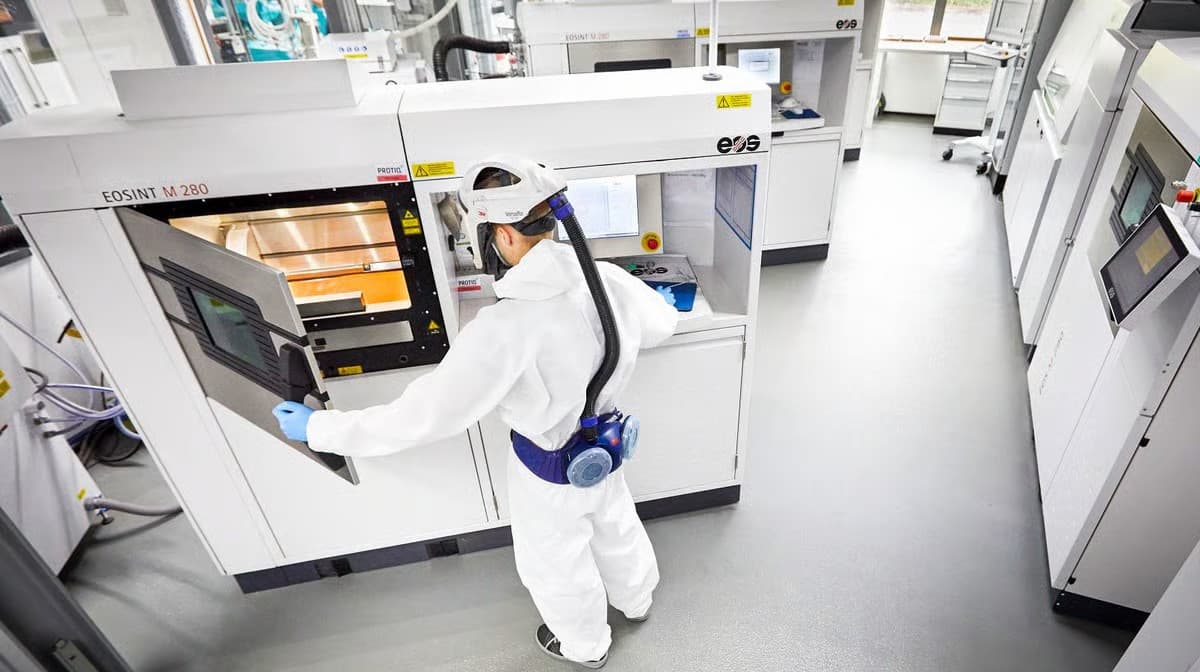
From prototyping and finishing to acceptance
Industrial AM: four checks before RFQ
- Function
State what the part must do and where it will be used
- Material and process
Name the required grade or performance range
- Design controls
Mark critical geometry, orientation and finishing
- Acceptance
Define dimensions, tests and required records
Pre-RFQ review: recommended practice and common mistakes
| Recommended practice | Common mistake |
|---|---|
| Qualify a process, a material, and a finish together as one released package | Treat an approved prototype as proof of production capability |
| Require lot traceability from powder receipt through final inspection | Let parameters, recoater blades, or powder suppliers change without re-qualification |
| Pick a supplier whose certifications already match your end market | Assume AM unit cost falls with volume — it mostly doesn't |
- End-use volume, variant count, and lifecycle duration documented.
- Process selected based on geometry, material, and economics, not brand.
- Material qualified in finished condition, including post-processing steps.
- Supplier certifications (ISO 9001 / AS9100 / ISO 13485) match end market.
- Lot traceability path defined from powder to CoC.
FAQ, further reading and sources
What should you define first for Industrial AM?
Define the operating environment, functional load, quantity and acceptance criteria before choosing a process. Those requirements determine the material, design rules and inspection plan.
Can the typical values in this guide be released directly on a drawing?
No. Use them for early design, then confirm the exact grade, supplier capability, DFM response and first-article result.
What should be locked before scaling production?
Lock the material, process settings, orientation, finishing and inspection method. Confirm that different lots reproduce the first-article result before scaling.
Next, explore 3D printing services, materials, online quoting, and the related design guides linked below.