Aerospace Manufacturing Methods for Prototyping and Production

Content in this Article
Aerospace process selection must align with the regulatory path, material evidence, validation plan and change control. Early models can favor speed; representative test parts require controlled records.
- Define function, environment, quantity and risk before selecting a material or process.
- Treat typical values as comparison points; confirm the exact grade and supplier capability before release.
- Use a first article or pilot lot to verify dimensions, function and records before scaling.

Define the decision
Document function, environment, quantity and risk so every option is compared against the same requirement.
The Regulatory Stack You Are Actually Building Into
Before a process choice, before a material choice, there is a certification basis. Commercial transport flies under 14 CFR Part 25 (FAA) or CS-25 (EASA); the supplier ecosystem operates under AS9100 quality, AS9102 first-article inspection, and AS9145 APQP.
| Standard | Scope | Who enforces | What breaks without it |
|---|---|---|---|
| AS9100 Rev D | QMS baseline for aerospace | IAQG / registrars | cannot quote most primes |
| AS9102 Rev C | First-article inspection | prime contractors | FAI rejection, re-work |
| AS9145 | APQP and PPAP for aerospace | prime contractors | phase-gate stalls |
| AS9146 | Foreign-object-damage (FOD) programme | prime contractors | delivery hold |
| Nadcap AC7004 | Base QMS for special processes | PRI | process accreditation lost |
Aerospace evaluation flow
Define requirements, narrow the material and process, then verify with a consistent acceptance method.
- 1Requirements
Function, environment, quantity and risk
- 2Options
Material, process, design controls and finishing
- 3Acceptance
Dimensions, functional tests and production records
Compare the practical options
Compare material, process, design controls and finishing together—not unit price alone.
Production Process Selection for Low-Volume Realities
| Process | Sweet-spot volume | Typical material spec | Lead time | Notes |
|---|---|---|---|---|
| 5-axis machining | 50–5,000 / yr | AMS 4928 Ti, AMS 4027 Al | 6–12 wk | monolithic structure, brackets |
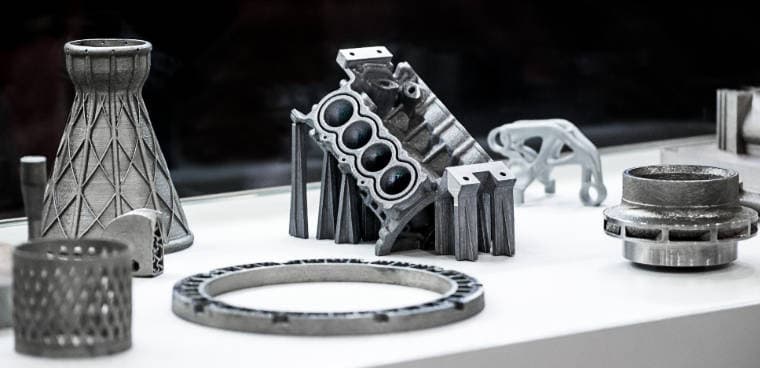
| DMLS (LPBF) | 10–1,500 / yr | AMS 7010 Ti, AMS 5662 Inconel | 4–10 wk | fuel nozzles, heat exchangers |
| Investment cast + HIP | 200–10,000 / yr | AMS 5383 CoCr, AMS 5397 | 14–22 wk | turbine hot section |
| Hand / automated layup + autoclave | 20–2,000 / yr | Hexcel 8552 IM7, Cycom 5320 | 8–16 wk | primary structure, skins |
| Sheet metal + chem-mill | 500–20,000 / yr | AMS-QQ-A-250/12 | 5–9 wk | fuselage skins, ribs |
Material Traceability Is the Real Deliverable
What the customer buys is not the part — it is the certified paper chain behind the part. Every heat lot, every powder lot, every layup batch must trace upstream to a mill test report and downstream to an installed airframe by serial number.

Validate before scaling
Before scaling, verify dimensions, function and records with one controlled method across representative lots.
Pre-RFQ review: recommended practice and common mistakes
| Recommended practice | Common mistake |
|---|---|
| Document function, environment, quantity and risk | Select from a material name or machine specification alone |
| Review material, process, design controls and finishing together | Address manufacturing limits only after design freeze |
| Inspect critical dimensions and function on the first article | Scale production from visual approval alone |
| Keep material, revision and inspection records | Reuse old results after a material or process change |
- Function, environment, quantity and risk are documented
- Material, process, design controls and finishing are reviewed with the supplier
- Critical dimensions, appearance and functional acceptance are on the drawing or RFQ
- First-article or pilot-lot verification is planned
- Material, process and revision changes trigger a new review
FAQ, further reading and sources
What should be defined first for Aerospace?
Start with function, environment, quantity and acceptance criteria. These inputs narrow the practical options faster than naming a machine or material first.
Can typical values in this article be released directly on a drawing?
No. Use them for early comparison, then confirm the exact grade, supplier capability and first-article result.
When is the process ready to scale?
Scale only after material, process, finishing and inspection are controlled and repeatable across representative lots.
Next, explore 3D printing services, CNC machining, materials, and the related reports linked on this page.