
Corrosion-Resistant Metals: Mechanism-Driven Selection Guide
Content in this Article
Metals can look straightforward in CAD and still fail after printing, finishing or inspection. The useful question is not whether a process can make the geometry once, but whether the chosen material, orientation and acceptance method can deliver the required function repeatedly. This guide turns that decision into a practical review workflow.
- Define the operating environment, functional load, quantity and acceptance criteria before choosing a process.
- Treat dimensions and performance values as design-starting points; confirm the exact grade and supplier capability before release.
- Use a first article or pilot lot to lock inspection and process controls before scaling.
Start with requirements and process selection
The Right Metal Depends on the Corrosion Mechanism
Engineers tend to ask 'is this alloy corrosion-resistant? ' as though corrosion were a single property. It is not.
Seven Corrosion Mechanisms and Which Metals Resist Each
Each mechanism has a distinct trigger and a distinct alloy response. Pitting and crevice attack share chemistry (chloride ingress through the passive film) but crevice attack initiates at lower chloride concentrations because the local pH drops faster in stagnant geometry. Stress corrosion cracking (SCC) is environment-plus-tensile-stress and is the failure mode that bites austenitic stainless above 60 degrees C in chlorides — duplex grades suppress it through their ferritic phase.
| Mechanism | Trigger | Best-Resisting Families | Avoid |
|---|---|---|---|
| Uniform / general | Acid or alkali below passivation range | Hastelloy C-276, titanium, Inconel 625 | Carbon steel, low-Cr stainless |
| Pitting | Cl- ions + oxidiser, T > 30 C | Super duplex 2507, 6Mo (254 SMO), titanium | 304, 316 in hot seawater |
| Crevice | Stagnant Cl- in gaskets, threads, deposits | Titanium, Hastelloy C-276, super duplex | All standard stainless under deposits |
| Galvanic | Dissimilar metals + electrolyte | Use same family or insulate | Al-Cu, steel-stainless wet contact |
| SCC (chloride) | Tensile stress + Cl- + heat | Duplex 2205, super duplex, ferritic | 304, 316, 321 above 60 C |
| Intergranular | Sensitised HAZ after welding | L-grades (304L, 316L), 321, 347 | Standard 304, 316 thick weldments |
Metals: define requirements before selecting a process
Connect requirements, process decisions and inspection before the first build to reduce late design changes.
- 1Requirements
Function, service environment, quantity and failure risk
- 2Material and process
Material grade, build strategy, geometry and finishing
- 3Inspection
Critical dimensions, functional tests and lot records
Key design rules
Environment-to-Metal Selection Matrix
This is the table most engineers actually need. Read it as 'first choice / acceptable / avoid'. Concentrations and temperatures shift the answer dramatically: 65 percent nitric acid passivates stainless beautifully, 95 percent attacks it.
| Environment | First Choice | Acceptable | Avoid |
|---|---|---|---|
| Atmospheric, urban | 304 | Galvanised steel, Al 5052 | Carbon steel unpainted |
| Coastal splash, < 30 C | 316L | Duplex 2205 | 304 |
| Seawater, 30–50 C, flowing | Super duplex 2507, Ti Gr 2 | 6Mo 254 SMO | 316L, 304 |
| Seawater, stagnant or crevice | Titanium Gr 2 | Hastelloy C-276 | All stainless including duplex |
| Sulfuric < 10%, hot | Hastelloy B-3 | Inconel 625 | Stainless, duplex |
| Sulfuric > 93%, ambient | Carbon steel | 304 | Hastelloy B (preferential attack) |
Galvanic Series and Dissimilar-Metal Joints
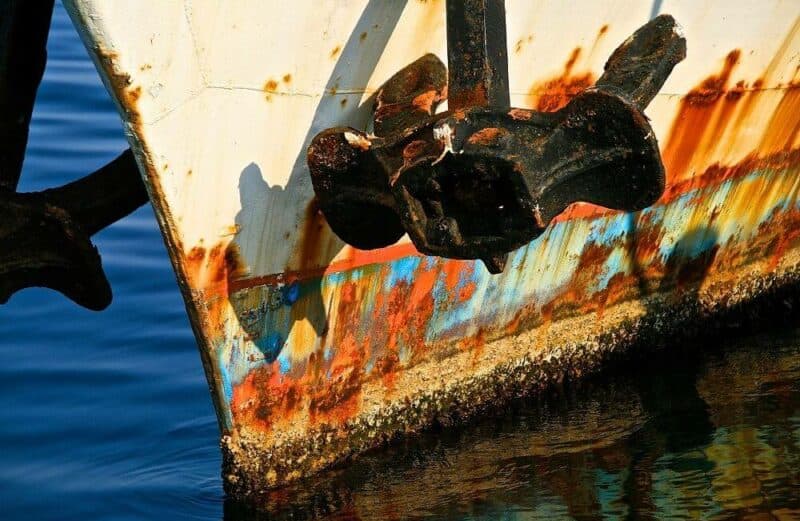
The galvanic series, ordered from anodic (sacrificial) to cathodic (protected) in flowing seawater, runs roughly: magnesium, zinc, galvanised steel, aluminium alloys, mild steel, cast iron, 304/316 (active), brass, copper, bronze, Cu-Ni, Monel, 304/316 (passive), titanium, Hastelloy C, graphite. The further apart two metals sit, the larger the driving voltage when they touch in an electrolyte. The classic failure is a carbon steel flange bolted to a 316 valve in a salt-water line: the flange becomes the anode, and corrodes about ten times faster than it would on its own.
Area ratio matters as much as alloy choice. A small anode connected to a large cathode (a steel bolt in a stainless plate) corrodes catastrophically; the reverse — a small cathode in a large anode — is benign. This is why stainless fasteners in carbon steel plate are acceptable but carbon steel fasteners in stainless are not.
| Material | Relative Cost (vs 304 = 1.0) | Marginal Performance Gain |
|---|---|---|
| Carbon steel | 0.3 | Baseline; needs coating |
| 304 / 304L | 1.0 | General atmospheric |
| 316 / 316L | 1.4 | Adds Cl- pitting resistance up to ~30 C |
| Duplex 2205 | 1.8 | Doubles strength, suppresses SCC |
| Super duplex 2507 | 2.6 | Hot seawater capable |
| 6Mo 254 SMO | 3.2 | Hot brine, bleach |
From prototyping and finishing to acceptance
Food-Processing Tank with CIP Chemistry
A juice processing line used 304 jacketed tanks cleaned daily with 70 degree C 2 percent caustic and a chlorinated sanitiser rinse. Within 18 months, SCC cracks appeared near the lower weld at the agitator boss. Root cause: residual welding stress plus chloride from the sanitiser plus 70 degree C — textbook chloride SCC of austenitic stainless.
Metals: four checks before RFQ
- Function
State what the part must do and where it will be used
- Material and process
Name the required grade or performance range
- Design controls
Mark critical geometry, orientation and finishing
- Acceptance
Define dimensions, tests and required records
Pre-RFQ review: recommended practice and common mistakes
| Recommended practice | Common mistake |
|---|---|
| Identify dominant corrosion mechanism first | Specify '316' for any wet application |
| Match PREN to chloride and temperature | Assume duplex is always better than 316 |
| Use L-grades or stabilised grades for thick weldments | Weld 304 above 6 mm without considering sensitisation |
| Insulate dissimilar metal joints in electrolyte | Bolt carbon steel directly to stainless in marine air |
| Solution-anneal SCC-prone weldments | Leave residual welding stress in chloride service |
| Run a coupon test in real process fluid | Trust generic iso-corrosion charts for trace contaminants |
- Service fluid: composition including trace Cl-, S, F, dissolved O2
- Temperature range: nominal, max upset, freeze
- Pressure and stress level (yield-fraction)
- Flow regime: stagnant, laminar, turbulent, two-phase
- Crevice geometry: gaskets, threads, deposits, weld backings
FAQ, further reading and sources
What should you define first for Metals?
Define the operating environment, functional load, quantity and acceptance criteria before choosing a process. Those requirements determine the material, design rules and inspection plan.
Can the typical values in this guide be released directly on a drawing?
No. Use them for early design, then confirm the exact grade, supplier capability, DFM response and first-article result.
What should be locked before scaling production?
Lock the material, process settings, orientation, finishing and inspection method. Confirm that different lots reproduce the first-article result before scaling.
Next, explore 3D printing services, materials, online quoting, and the related design guides linked below.