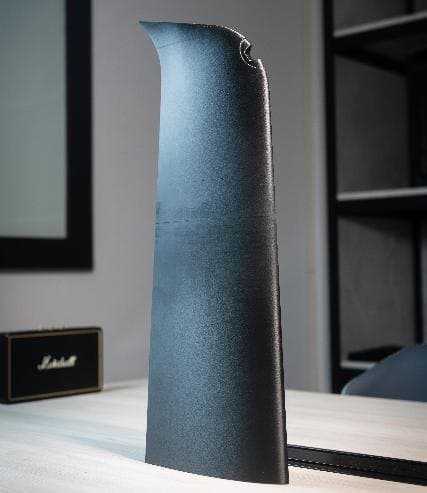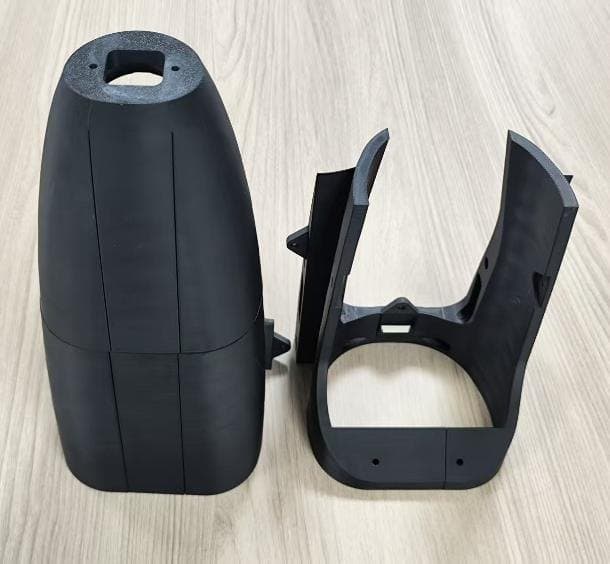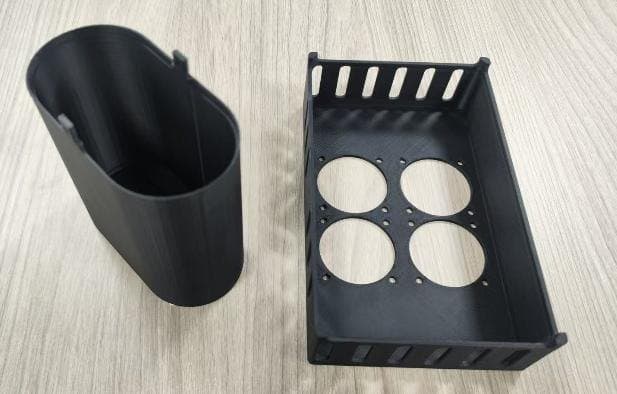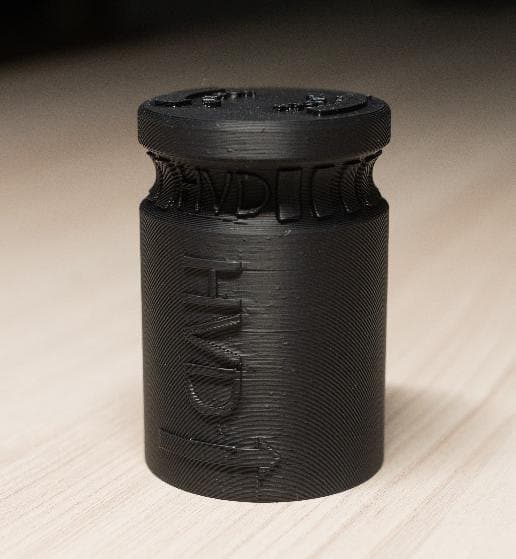

Overview
PEKK (polyetherketoneketone) is a PAEK-family polymer with two ketone linkages and one ether linkage per repeat unit. Its slower crystallisation makes it substantially easier to print than PEEK — lower warping, smoother surfaces and a print window 50–60°C lower — while keeping PAEK-class strength and a 162°C glass transition.
Stratasys Antero® 800NA is the canonical neat grade; Antero® 840CN03 adds 3% carbon nanotubes for a tunable 10⁴–10⁹ Ω/sq ESD surface. Both exceed NASA ASTM E595 outgassing limits, making PEKK one of the few FDM materials qualified for spacecraft and vacuum service (used on Lockheed Martin's Orion hatch covers).
Key Properties
Typical datasheet values; printed parts are anisotropic and XY-direction values are shown unless noted.
| Property | Value |
|---|---|
| Density | 1.27 g/cm³ |
| Tensile strength (XZ) | 93.1 MPa |
| Tensile modulus | 4100 MPa |
| Elongation at break | 15–20 % |
| Izod impact (notched) | 50 J/m |
| Glass transition (Tg) | 162 °C |
| HDT @ 1.82 MPa | 150 °C |
| HDT @ 0.45 MPa | 165 °C |
Typical Applications
- Spacecraft interior and vacuum-chamber components (low-outgassing)
- Aerospace parts in jet-fuel and hydraulic-fluid contact
- ESD-sensitive electronics housings (Antero 840CN03)
- Weight-critical aerospace brackets and ducting
Printing & Handling Notes
As-printed parts are largely amorphous (≈5–10% crystallinity); anneal at 200°C for 1–2 h to develop ≈20–30% crystallinity and final properties. Print with a 340–380°C nozzle, active 130–160°C chamber and 120–150°C bed after drying at 120–150°C for 6–12 h.