
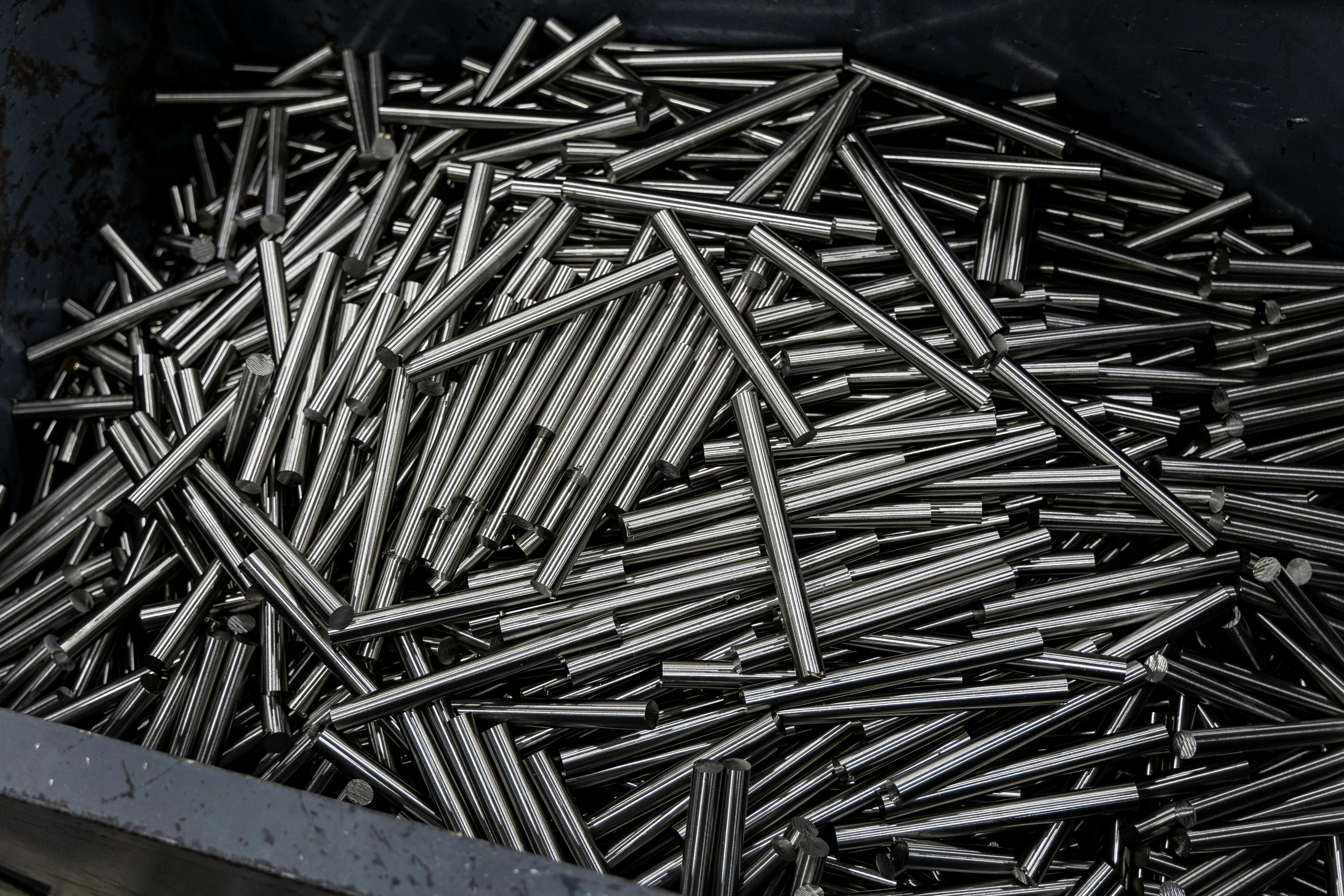
Overview
Stainless steel is an iron-chromium alloy defined by a chromium content of at least 10.5%. That chromium reacts with ambient oxygen to form a two-to-five nanometer passive layer of Cr2O3 on the surface. The layer self-heals when scratched, and it is the entire reason stainless resists rust without plating, paint, or oil. Remove the chromium below 10.5% and you have carbon steel with cosmetic shine; keep it above and you have a family that covers everything from kitchen sinks to subsea manifolds.
The family splits into five microstructural classes. Austenitic 300-series (304, 316, 321) is non-magnetic, weldable, and the volume baseline. Ferritic 400-series (430, 439) is magnetic, cheaper, less formable. Martensitic (410, 416, 420, 440C) hardens by quench and temper like tool steel. Duplex (2205, 2507) is roughly 50/50 austenite-ferrite with double the yield of 304 and superior chloride pitting resistance. Precipitation-hardened (17-4 PH, 15-5 PH) solution-anneals soft then ages to 1100 MPa yield in four hours.
In the shop, 304 and 316 dominate sheet fabrication and general CNC. 303 and 416 are the free-machining picks for high-volume turned parts. 17-4 PH H900 is the aerospace and injection-mold-cavity standard. 316L and 17-4 PH are the two stainless powders you actually see in DMLS. MIM (metal injection molding) handles small 17-4 and 316L parts in 5,000-plus volumes where CNC cycle time makes the unit cost untenable.
Because yield strength across the family varies from 200 MPa (annealed 304) to 1,170 MPa (17-4 H900) and pitting resistance equivalent number (PREN) swings from 17 to 43, writing only stainless steel on a drawing is insufficient for anything structural, regulated, or coastal. Specify the grade, the temper or heat-treat condition, and the passivation spec.
Why It Earns a Place in Your BOM
The engineering argument for stainless is rarely peak strength; it is the bundle of passive corrosion, service temperature, cleanability, and aesthetics in one material. Austenitic 304 holds usable strength from liquid-nitrogen cryogenic down to 870 C short-term, and the chromium oxide survives boiling water, diluted bleach, citric acid, and saltwater mist without intervention. You do not schedule recoat cycles on a 316 railing; you schedule them on a powder-coated steel one.
The second argument is optical and tactile. A number-four brushed finish, a bead-blasted matte, an electropolished mirror, and a PVD black each come straight off the part with no paint stack to chip. For visible consumer hardware, medical trays, and food-equipment trim, stainless collapses a multi-step finishing BOM into one stock selection plus one finishing line. That is why appliances, elevator cabs, and surgical carts default to it even when load requirements are trivial.
The third argument is regulatory. FDA 21 CFR 175.300 (food contact), ASTM F899 and F138 (surgical and implant), ASME BPE (biopharm tubing), and NSF 51 all have stainless as the default approved path. When your part must ship into a regulated market and you want to avoid a one-year material qualification cycle, specifying 316L solves the problem by precedent.
Cost Per Part vs Alternatives
For a representative CNC bracket (120 x 80 x 25 mm, four features, bead-blast finish, quantity 25), the per-part pricing below reflects Asia and Mexico tier-1 shop quotes in Q1 2026. Stainless sits roughly 2x above 6061 aluminum but under half of titanium on identical geometry, because cycle time is the larger driver than raw material cost.
| Material | Per-part USD | Lead time | Best fit vs this spec |
|---|---|---|---|
| 6061-T6 aluminum | 95–160 | 3–5 days | Non-corrosive environment, weight-sensitive |
| 304 stainless | 180–280 | 5–8 days | General indoor, food, appliance |
| 316L stainless | 220–340 | 5–8 days | Coastal, medical, pharma |
| 17-4 PH H900 | 260–420 | 7–12 days | High-strength fixture, aerospace |
| Duplex 2205 | 340–520 | 10–15 days | Chloride service, subsea |
| Ti-6Al-4V Grade 5 | 620–980 | 10–14 days | Implant or aerospace weight-critical |
Grade Matrix Across the Stainless Family
Eight grades cover well over 95% of real specifications. Use this matrix to pick before you price. PREN is Pitting Resistance Equivalent Number (Cr + 3.3*Mo + 16*N); above 40 is considered seawater grade.
| Grade | Yield MPa | PREN | Best for | Watch out for |
|---|---|---|---|---|
| 303 austenitic | 240 | 18 | Free-machining turned parts, pins, shafts | Sulfur hurts corrosion and weldability |
| 304 / 304L | 205–290 | 19 | Sheet enclosures, food tanks, general CNC | Chloride pitting above 50 C |
| 316 / 316L | 205–290 | 25 | Marine, medical, pharma, chloride service | Stress corrosion cracking in hot chloride |
| 321 austenitic | 205 | 19 | Exhaust and 550–900 C creep service | Higher cost than 304 in thin sheet |
| 430 ferritic | 205 | 17 | Indoor appliance trim, automotive exhaust tips | Poor cold-weather impact, hard to weld |
| 416 martensitic | 275–760 | 13 | Hardenable shafts, valve stems | Marginal corrosion, avoid outdoors |
| 17-4 PH (H900) | 1,170 | 18 | Aerospace fittings, injection mold cavities, DMLS | Must re-age after welding |
| Duplex 2205 | 450 | 35 | Subsea, salt spray, chemical tanks | Limited above 300 C, harder to machine |
Process Compatibility
Not every grade runs on every process. 303 cannot be cast reliably because of its sulfur; 17-4 PH is the only mainstream stainless that DMLS prints to full strength after heat treatment. Use the table to short-list process and grade together.
| Process | Compatible grades | Typical tolerance | Notes |
|---|---|---|---|
| CNC milling / turning | 303, 304, 316, 416, 17-4, 2205 | ±0.05 mm | Cuts 40–60% of 6061 rate; use coated carbide |
| Sheet metal (laser + bend) | 304, 304L, 316, 316L, 430 | ±0.1 mm | Minimum bend radius 1x thickness |
| DMLS / L-PBF | 316L, 17-4 PH | ±0.1 mm + 0.1% length | Stress relieve at 650 C, HIP optional |
| Investment casting | 304, 316, 17-4 PH, CF8M | ±0.2 mm | Breaks even around 200–500 units |
| Metal injection molding | 316L, 17-4 PH, 420 | ±0.3% of dimension | Break-even above 5,000 parts, <100 g |
| Cold-rolled wire / fastener | 302, 304, 316, A286 | ISO 4759 | Work-hardened to class 70 or 80 |
Picking the Grade by Use Case
Reverse the decision flow: start from the part's environment and duty, then pick the grade and process. The table encodes the pairings our engineering desk uses for 80% of incoming RFQs.
| Use case | Recommended grade | Recommended process | Typical finish |
|---|---|---|---|
| Indoor appliance trim | 430 or 304 #4 | Laser + bend | #4 brush |
| Commercial kitchen tank | 304L | Laser + TIG weld | 2B mill, passivated |
| Coastal railing / fastener | 316 / 316L | CNC or wire | Electropolish |
| Surgical instrument | 17-4 PH H1025 or 420 | CNC + vacuum heat treat | Citric passivation, bead-blast |
| Subsea manifold | Duplex 2205 or Super-duplex 2507 | CNC from forged bar | Bead-blast, pickled |
| Aerospace bracket | 17-4 PH H900 or A286 | CNC or DMLS + HIP | Chromate + primer |
| Pharma wetted housing | 316L ASME BPE | CNC + electropolish | Ra <= 0.5 um |
Design Rules That Reward Stainless
Stainless work-hardens aggressively, so the worst thing you can do is design for a finish pass that dwells. Keep CNC pocket corner radii at minimum 30% of tool diameter (a 6 mm end-mill wants R1.8 minimum), keep wall thickness above 1.0 mm on machined parts and 0.9 mm on laser-cut sheet, and avoid narrow slots under 2 mm wide deeper than 10 mm. These are not aesthetic preferences; they directly control whether the shop hits the quoted price.
For welded 304/316L assemblies, specify post-weld passivation (ASTM A967 citric or nitric) as a separate drawing note. Austenitic stainless sensitizes and loses chromium to grain-boundary carbides if held between 425 and 870 C during welding; using the L low-carbon variants (304L, 316L) and keeping the heat input modest avoids intergranular corrosion downstream. For 17-4 PH, never weld a heat-treated part unless you have budgeted a full re-solution plus re-age (H900 takes four hours at 482 C in vacuum).
For DMLS 17-4, the build plate orientation drives fatigue. Orient cylindrical features vertically when fatigue matters, then stress-relieve, remove supports, HIP (103 MPa at 1,165 C for four hours), solution treat, and age. Skipping HIP leaves lack-of-fusion defects that halve fatigue life and explain most early-stage print failures.
Finishes and Post-Processing
Stainless accepts a wider finish menu than any other volume metal. The four you will specify 90% of the time: 2B mill finish (cold-rolled, annealed, lightly pickled, Ra ~0.3 um) for non-cosmetic sheet; number-four brushed (180–240 grit linear) for appliance panels and elevator cars; glass bead blasted for uniform matte with no directionality; and electropolished to Ra 0.1–0.4 um for pharma and implant hygiene plus micro-deburr in one bath.
Passivation (ASTM A967 citric Type II or nitric Type VI) is not a cosmetic step; it is a corrosion step. Machining leaves embedded iron from tooling, which rusts within hours in humid storage and reads as tea staining. Every stainless part for medical, food, pharma, or marine use should have a passivation callout. For 17-4 PH, passivate after the final age, not before.
PVD coatings (TiN gold, CrN silver, DLC black) add 2–4 um of ceramic hardness on top of the polish. They hold up to 25,000 watch-wear cycles and are the standard dark finish on premium faucets and EDC knives. For higher abrasion, nitriding the 17-4 surface lifts hardness from 40 HRC to 60+ HRC while retaining core toughness.
Application: Coastal Observatory Railing Upgrade
A Taiwan east-coast observatory replaced powder-coated carbon-steel railings that were rusting through in 18 months with 316L 50 x 50 x 3 mm box-section. Total length 420 m, fabricated by laser-tube, TIG-welded, post-weld pickled and passivated per ASTM A967, electropolished to Ra 0.6 um. Material cost jumped from USD 38,000 to USD 94,000 but the recoat line-item (USD 22,000 every 24 months) went to zero, and the first inspection at 30 months showed no visible pitting or tea staining.
The key spec detail: the contractor originally quoted 304. We pushed to 316L because the site sits 80 m from surf and sees daily salt aerosol above 50 g/m2. PREN 25 versus 19 is the difference between tolerable and safe here. Total lead time six weeks, installation by existing crew with standard MIG-pulsed equipment on argon-2%-CO2 shield.
Application: Surgical Instrument Set in 17-4 PH
A medical OEM consolidated a 24-piece orthopedic retractor tray from 420 martensitic (56 HRC but prone to chloride pitting in autoclave cycles) to 17-4 PH H1025. The new condition gives 1,000 MPa yield and 38 HRC hardness, survives 500 autoclave cycles at 134 C without surface degradation, and reduces rejected instruments at incoming QC from 6% to under 0.5%.
Manufacturing flow: CNC from annealed Condition A bar, stress relieve at 540 C, vacuum age H1025 for four hours at 552 C, citric passivation, bead-blast matte finish, laser mark with UDI per FDA 21 CFR 830. Unit cost rose from USD 62 to USD 78, but rework and field-return cost fell by USD 14 per unit, paying back on the first 3,000-instrument production lot over three months.
Application: DMLS 316L Manifold for Hydrogen Test Rig
A powertrain supplier replaced an eight-piece welded 316L manifold (12 port, 10 MPa working, -40 C to +120 C) with a single DMLS 316L build. Print time 46 hours on an EOS M290, powder reuse 18% virgin top-up, stress relief 650 C for two hours, HIP at 103 MPa and 1,150 C for four hours, then CNC finish on the 24 O-ring grooves to Ra 0.8 um. Weight dropped 41% (from 4.3 kg to 2.5 kg), internal volume fell 28%, and purge cycle time shortened from 42 to 27 seconds.
Unit cost for a pilot lot of 12 units came to USD 2,400 each (USD 800 machine time, USD 620 post-processing, USD 520 powder and consumables, USD 460 setup amortized). The welded predecessor had cost USD 1,950 but required 11 weeks lead time versus 2 weeks for the printed version, which is why the program accepted the price premium.
Do and Don't When Specifying Stainless
| Do | Don't |
|---|---|
| Write the exact grade and condition (316L, 17-4 PH H900) | Write only stainless steel on a drawing |
| Call out passivation spec (ASTM A967 Method 2) | Assume the shop passivates by default |
| Use L variants (304L, 316L) when welding | Weld standard 304/316 without post-weld solution anneal |
| Specify finish with Ra value and method | Write polished without a grit or Ra number |
| Allow 2–3x the CNC cycle budget of 6061 aluminum | Assume stainless quotes like aluminum |
| Use 316 or duplex within 1 km of saltwater | Assume 304 will survive coastal service |
Common Mistakes
| Mistake | Why it fails | How to avoid |
|---|---|---|
| Using 304 in chloride service | Pitting initiates above 50 C in saline | Upgrade to 316L (PREN 25) or duplex 2205 (PREN 35) |
| Welding 17-4 PH without re-age | HAZ loses H900 strength, cracks under load | Budget full re-solution plus re-age after welding |
| Skipping passivation after CNC | Free iron rusts within 24 hours, tea staining | Add ASTM A967 Method 2 citric passivation to the drawing |
| Holding 304 at 500–800 C (e.g. slow cool after weld) | Sensitization, intergranular corrosion | Use 304L / 316L and reduce heat input |
| DMLS 17-4 with no HIP | Lack-of-fusion voids halve fatigue life | HIP at 103 MPa and 1,165 C for 4 hours |
| Same-material 304 fasteners torqued dry | Thread galling and seizure during assembly | Apply nickel-based anti-seize or use 316 nut + 17-4 bolt |
Pre-Order Checklist
- Pick the grade by PREN and yield before quoting; do not leave it to the shop.
- Specify condition: annealed, H900, H1025, H1150, or 2B / #4 for sheet.
- Add passivation spec (ASTM A967 Method 2 citric is the default).
- Call out surface finish with Ra value plus method (bead-blast, electropolish, #4 brush).
- Define weld procedure and post-weld treatment on any assembly drawing.
- For DMLS parts, specify stress relief, HIP, solution treat, and age as separate process steps.
- Confirm certifications required: 3.1 mill cert, ASTM F136, ASME BPE, or FDA 21 CFR callouts.
- Budget CNC lead time at 2–3x the equivalent aluminum quote before committing to a ship date.
Design Takeaways
Stainless is specified correctly when the drawing names a grade, a condition, a finish with numbers, and a passivation standard. Anything short of that leaves too much interpretation space between engineer and shop, and the failures show up later as rust streaks, galled threads, or field cracks during the first service inspection. The per-part premium over aluminum is real—about 2x in machining, 1.5x in sheet—but collapses against the lifetime cost of recoating, recalling, or requalifying.
Pick the grade from PREN and yield, pick the process from geometry and volume, and pick the finish from the environment and the observer's eye distance. Do those three decisions on paper before the RFQ goes out, and the shop's quote will come back narrower and faster than if you asked for stainless steel and let them guess.